
Why Small Businesses Need a Company Website Instead of Relying Only on Social Media
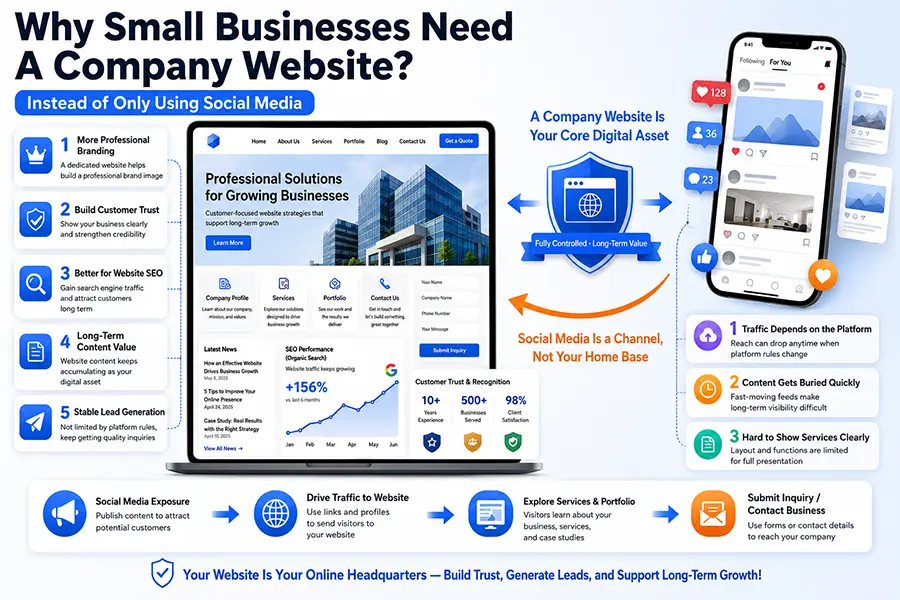
In today’s business environment, many small and medium-sized businesses use platforms such as Facebook, Instagram, WeChat, LinkedIn, TikTok, or other social media channels to promote their products and services. Social media is convenient, fast, interactive, and useful for showing customers daily updates, promotions, and business activities.
Because of this, some business owners may wonder: if social media allows companies to publish content for free, why should a business still invest in a company website?
This is a very practical question, especially for small businesses with limited marketing budgets. Every marketing expense needs to create value. However, from the perspective of long-term brand building, customer trust, Google visibility, and website SEO, relying only on social media without having a company website is a major risk.
Social media can be a marketing channel, but a company website is the official online presence and core digital asset of a business.
1. A Company Website Is Your Own Online Asset
A social media account may look like it belongs to your business, but the platform rules are not controlled by you. Social media platforms can change algorithms, limit organic reach, suspend accounts, remove content, or restrict visibility without much notice. The followers, posts, and customer interactions that a business has worked hard to build all depend on third-party platform policies.
A company website is different. An independent domain name, such as yourcompany.com, is a digital asset that belongs to your business. You can freely display your company profile, services, products, case studies, customer reviews, contact forms, maps, blog articles, and SEO content.
No matter how social media platforms change, your company website can continue to exist, grow, and accumulate long-term brand value.
For small businesses, a company website is not just a webpage. It is the foundation of your online business presence.
2. A Company Website Builds More Customer Trust
When potential customers hear about a business for the first time, they often search for the company name, services, or related keywords on Google. If they only find a social media page and no official company website, they may feel that the business is small, incomplete, or not professional enough.
A well-designed company website helps customers quickly understand who you are, what services you provide, where you are located, whether you have real experience, and how they can contact you.
This is especially important for industries such as website design, renovation, education, healthcare, legal services, accounting, logistics, security systems, restaurants, beauty services, and real estate. Before making a decision, customers usually want to see more complete and professional information.
Social media is good for daily updates. A company website is better for building trust. The two serve different purposes and cannot fully replace each other.
3. Social Media Content Disappears Quickly, While Website Content Lasts Longer
The life cycle of social media content is usually very short. A post may receive views for a few hours or a few days, but it will soon be buried by newer content. Even if your business posted an important service description, pricing update, or project case in the past, customers may have difficulty finding it later.
A company website has a much clearer content structure. Pages such as Home, About Us, Services, Products, Portfolio, Blog, and Contact can all have fixed positions. Customers can easily find the information they need through the navigation menu, internal links, or Google search.
More importantly, website content can be indexed by Google. A high-quality SEO article may continue to bring search traffic for months or even years. This long-term value is difficult to achieve through social media alone.
4. A Company Website Is the Foundation of Website SEO
Many small businesses want customers to find them on Google when searching for keywords such as “Vancouver website design,” “Langley daycare,” “Surrey security camera,” “Coquitlam preschool,” or other local service terms. Without a company website, it is very difficult to build a complete website SEO strategy.
Website SEO requires page titles, meta descriptions, H1 and H2 headings, keyword structure, internal links, image alt text, website speed optimization, mobile optimization, sitemap setup, and structured content. These elements need to be built on a proper company website.
Social media pages may sometimes appear in search results, but businesses have limited control over page structure and keyword targeting. In comparison, a company website allows you to create dedicated pages for each service, location, product, and customer question. This gives your business more opportunities to appear in Google search results.
5. A Company Website Presents Products and Services More Clearly
Social media is suitable for short posts, but it is not ideal for presenting complex services in a structured way. For example, a renovation company may need to show different project case studies. A daycare may need to introduce programs, teachers, facilities, and registration steps. A security company may need to explain different camera systems. A website design company may need to show service packages, portfolio examples, and customer reviews.
If all this information is placed only on social media, it can become scattered and difficult to search. It also may not help customers make confident decisions.
A company website can be designed according to the customer journey. Visitors can learn about your business step by step, understand your advantages, view examples, read reviews, and finally submit a form, call your business, or send an email.
A good company website does not only display information. It helps turn visitors into potential customers.
6. A Company Website Improves Advertising Performance and Conversion Rates
Many businesses run Google Ads, Facebook Ads, Instagram Ads, or other online advertising campaigns. If the ad sends visitors only to a social media page, customers may be distracted by other posts, notifications, comments, or unrelated content. They may also have difficulty finding the exact information they need.
If the ad sends visitors to a dedicated landing page on your company website, the result is often better. A landing page can focus on one clear goal, such as booking a consultation, requesting a quote, registering online, downloading information, or purchasing a product.
A website landing page can include service benefits, customer reviews, frequently asked questions, project photos, contact information, and clear call-to-action buttons.
From an advertising perspective, a company website gives your business better control over customer experience. It also makes it easier to analyze visitor data, including page views, time on page, form submissions, phone clicks, and conversion sources.
7. A Company Website Makes Your Brand Look More Professional
Most social media pages use similar templates. It is difficult for a business to fully express its brand identity through social media alone. The layout, colors, navigation, content hierarchy, and user experience are all limited by the platform.
A company website can be professionally designed based on your brand identity. You can use your own logo, brand colors, image style, service descriptions, page structure, and visual system.
A professional website makes customers feel that your company is more stable, trustworthy, and capable.
For small businesses, professional image is very important. Customers often compare several companies before making a decision. If your competitors have clear and professional websites while your business only has a social media page, potential customers may contact your competitors first.
8. The Best Strategy Is Not Website or Social Media — It Is Both
A company website and social media should not compete with each other. They should work together.
The company website should be the core platform for brand trust, Google search traffic, complete business information, lead generation, and customer conversion. Social media should be used for daily exposure, customer interaction, activity promotion, and content distribution.
The right strategy is to use your company website as the main platform and social media as a traffic channel. Social media posts can link to your website articles, service pages, landing pages, or case studies. Your website can also display social media links so customers can follow your latest updates.
This approach allows your business to benefit from the visibility of social media while continuing to build long-term SEO value and brand assets through your website.
Conclusion: Small Businesses Need a Website That Truly Belongs to Them
For small businesses, social media is important, but it cannot replace a company website. Relying only on social media means building your online business on someone else’s platform. If platform rules change, account access is restricted, or organic reach drops, your business can become very passive.
A company website is your online headquarters. It is the foundation for customer trust, Google indexing, website SEO, advertising conversion, and long-term brand building.
A professional, fast, clear, and mobile-friendly website can help small businesses gain more customer trust and build a stronger foundation for long-term website SEO.
PPIT specializes in website design, WordPress website development, website maintenance, and website SEO services for small and medium-sized businesses in Canada. If your business currently only has social media pages and does not yet have an official company website, now is the right time to build your own business website and create a more stable foundation for brand promotion and Google search visibility.

